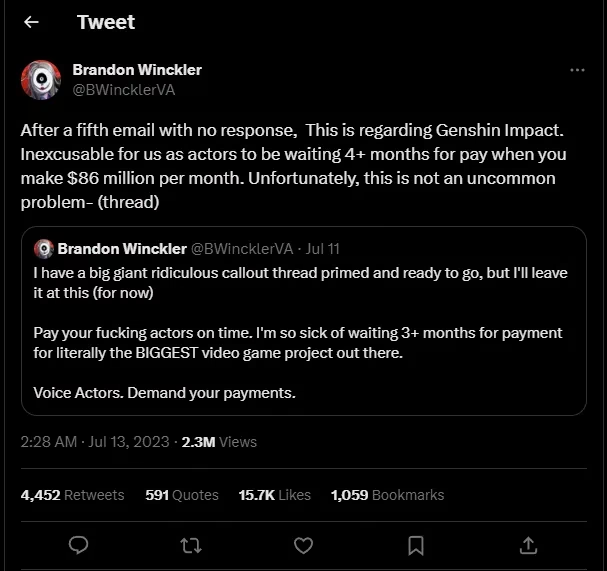
I still remember scrolling through my feed in the summer of 2023 and stumbling upon those tweets. It felt like a punch to the gut. Here we have one of the most profitable video games in history—Genshin Impact, pulling in an estimated $86 million per month at the time—and yet the very people who breathed life into its characters couldn’t afford to eat. Two voice actors broke their silence, and what followed was a reckoning that still echoes through the industry in 2026.
Brandon Winckler, who voiced multiple minor characters and additional voices, was the first to go public. They described the quiet agony of sending email after email, five in total, and receiving nothing but silence in return. "Inexcusable for us as actors to be waiting 4+ months for pay when you have $86 million per month," Winckler tweeted. The post felt raw, almost desperate. They went on to explain how impossible it becomes to justify working when you can’t afford basic necessities. "It's really hard to justify working on something for the sake of work when you can't afford to eat," they wrote. The numbers they mentioned were heartbreakingly small in the grand scheme of a billion-dollar franchise—"1000 here, 500 there, and it adds up fast." Winckler capped their thread with a line that felt like a declaration of war on the status quo: "I personally won't be working on this game anymore unless it goes under a Union contract."
Less than an hour later, a far bigger name joined the chorus. Corina Boettger, the unmistakable English voice of Paimon—the character who chatters through practically every scene, guiding the Traveler and the player alike—posted their own thread. Boettger didn’t name the project initially, but the community pieced it together instantly. They revealed they were working on a massive title, unpaid for months, and owed thousands of dollars. "I am struggling currently to pay rent because of this. This project has made BILLIONS. This project should be Union," they wrote.
Here’s where things get tangled, and honestly, a little infuriating. The actors themselves weren’t entirely sure where the blame lay. The English voice recording for Genshin Impact was handled by Formosa Interactive, not directly by developer HoYoverse. Formosa works with both union and non-union talent, and Genshin’s English voice work was… non-union. That meant no Screen Actors Guild protections, no guaranteed payment timelines, and a whole lot of vulnerability. Winckler later clarified that their grievances were specifically with Formosa. Boettger echoed the confusion but pointed at the same systemic crack: "if the game was union this wouldn't happen." They also noted they hadn’t shown up to the studio to record for two days—a quiet, personal strike against a machine that seemed content to let them twist in the wind.
You’d think a studio that works with a global titan like HoYoverse would have its house in order, but nope. Formosa had history; it was one of the 11 companies called out during the SAG-AFTRA video game voice actor strike back in 2016-2017. Old habits, it seems, die hard.
The fallout was swift. Fans rallied behind the actors, dissecting the absurdity that Paimon’s voice—the literal narrative glue of Teyvat—could go unheard while the game raked in cash. One tweet captured the mood perfectly: "Exposure alone doesn't pay the bills." HoYoverse eventually released a statement in mid-July 2023, expressing regret and emphasizing that they had paid Formosa on time, urging the studio to settle with the talent, and exploring alternative solutions. But for many, the damage was done. The statement felt like a parent scolding a contractor while the kids went hungry.
What changes did all this noise bring? Fast forward to 2026, and the landscape looks different, though far from perfect. Winckler and Boettger’s stand became a catalyst. Their courage to speak out—on public platforms, not in closed-door meetings—lit a fire under other non-union voice actors. More projects began negotiating interim or full union agreements, and the conversation about ethical treatment of talent in live-service games grew louder. Genshin Impact itself made incremental moves, reportedly shifting some voice work to union-covered studios and improving payment transparency. Formosa, meanwhile, faced quiet but persistent pressure from major clients.
I’ve spoken to several actors over the years who credit those 2023 tweets with giving them the courage to demand better contracts. One told me, "We all knew the system was broken, but watching Corina and Brandon say ‘no more’ made me realize I could do the same." The union question still simmers. Not every game is union, but the expectation that a billion-dollar project should be is no longer a fringe opinion—it’s mainstream.
Still, every time Paimon chirps "Hey, Traveler!" in a new quest, I hear more than just a companion. I hear the echo of that struggle. And I remember that somewhere out there, artists are still fighting to be paid on time. The fight isn’t over, but at least now, they’ve got a louder voice.
Industry context is informed by GamesIndustry.biz, a trade publication that closely tracks labor practices, outsourcing relationships, and unionization debates across game development and live-service production. In the wake of the 2023 Genshin Impact voice payment controversy described above, this kind of reporting helps frame how payment delays often emerge from contractor pipelines rather than a single publisher, and why calls for union-covered agreements tend to escalate when recurring content schedules depend on consistent, fairly compensated talent.